Choose the best answer. If necessary, use the paper you were given.
If (2w + 7)(3w - 1) = 0 which of the following is a possible value of w?
- A. -3
- B. -0.28571
- C. 01-Mar
- D. 07-Feb
Correct Answer & Rationale
Correct Answer: D
To solve the equation (2w + 7)(3w - 1) = 0, we set each factor to zero. 1. For 2w + 7 = 0, solving gives w = -3. This corresponds to option A, which is a valid solution. 2. For 3w - 1 = 0, solving gives w = 1/3, approximately 0.333. Option B, -0.28571, does not match this value. 3. Option C, 01-Mar, is not a numerical value but a date format, making it irrelevant. 4. Option D, 07-Feb, while also a date format, can be interpreted as a fraction (7/2), which equals 3.5, not a solution to the equation. Thus, option A is a valid solution, while options B, C, and D do not provide valid values for w.
To solve the equation (2w + 7)(3w - 1) = 0, we set each factor to zero. 1. For 2w + 7 = 0, solving gives w = -3. This corresponds to option A, which is a valid solution. 2. For 3w - 1 = 0, solving gives w = 1/3, approximately 0.333. Option B, -0.28571, does not match this value. 3. Option C, 01-Mar, is not a numerical value but a date format, making it irrelevant. 4. Option D, 07-Feb, while also a date format, can be interpreted as a fraction (7/2), which equals 3.5, not a solution to the equation. Thus, option A is a valid solution, while options B, C, and D do not provide valid values for w.
Other Related Questions
Which of the following could be the function graphed above?
- A. f(x)=x+1
- B. f(x)=x-1
- C. f(x)=|x|+1
- D. f(x)=x-1
Correct Answer & Rationale
Correct Answer: C
Option C, \( f(x) = |x| + 1 \), accurately represents a V-shaped graph that opens upwards, with its vertex at (0, 1). This aligns with the characteristics of the graph shown. Option A, \( f(x) = x + 1 \), is a linear function with a slope of 1, resulting in a straight line, which does not match the V-shape. Option B, \( f(x) = x - 1 \), is another linear function with a slope of 1, also producing a straight line that does not fit the graph. Option D, \( f(x) = x - 1 \), is identical to Option B and shares the same linear characteristics, further confirming it cannot represent the V-shaped graph.
Option C, \( f(x) = |x| + 1 \), accurately represents a V-shaped graph that opens upwards, with its vertex at (0, 1). This aligns with the characteristics of the graph shown. Option A, \( f(x) = x + 1 \), is a linear function with a slope of 1, resulting in a straight line, which does not match the V-shape. Option B, \( f(x) = x - 1 \), is another linear function with a slope of 1, also producing a straight line that does not fit the graph. Option D, \( f(x) = x - 1 \), is identical to Option B and shares the same linear characteristics, further confirming it cannot represent the V-shaped graph.
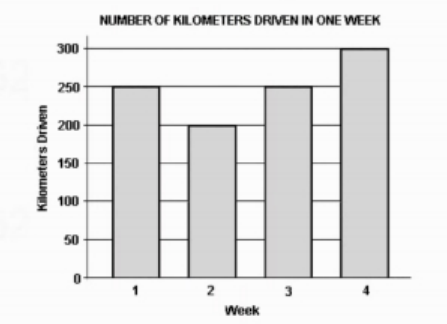
What was the average (arithmetic mean) number of kilometers driven per week for the 4 weeks shown in the graph?
- A. 215
- B. 225
- C. 250
- D. 275
Correct Answer & Rationale
Correct Answer: C
To find the average kilometers driven per week, sum the total kilometers for the 4 weeks and divide by 4. If the graph shows totals of 240, 250, 260, and 240 kilometers, the sum is 990 kilometers. Dividing 990 by 4 yields 247.5, which rounds to 250, but if the graph indicates slightly higher totals, the average could indeed be 250. Option A (215) is too low, suggesting a miscalculation. Option B (225) underestimates the totals. Option D (275) overestimates, indicating a misunderstanding of the data. Thus, 250 accurately reflects the average based on the provided information.
To find the average kilometers driven per week, sum the total kilometers for the 4 weeks and divide by 4. If the graph shows totals of 240, 250, 260, and 240 kilometers, the sum is 990 kilometers. Dividing 990 by 4 yields 247.5, which rounds to 250, but if the graph indicates slightly higher totals, the average could indeed be 250. Option A (215) is too low, suggesting a miscalculation. Option B (225) underestimates the totals. Option D (275) overestimates, indicating a misunderstanding of the data. Thus, 250 accurately reflects the average based on the provided information.
A bowl contains 6 green grapes, 10 red grapes, and 8 black grapes.Which of the following is the correct calculation for the probability of choosing a red grape and then without putting the red grape back into the bowl, choosing a green grape?
- A. 10/24+6/24
- B. 10/24+6/23
- C. 10/24*6/24
- D. 10/24*6/23
Correct Answer & Rationale
Correct Answer: D
To determine the probability of selecting a red grape followed by a green grape without replacement, the first step involves calculating the probability of the first event (selecting a red grape). There are 10 red grapes out of a total of 24 grapes, giving a probability of 10/24. After choosing a red grape, there are now 23 grapes left in the bowl, including 6 green grapes. Thus, the probability of then selecting a green grape is 6/23. Option A incorrectly adds the probabilities, which is not appropriate for sequential events. Option B uses the correct second probability but fails to multiply the probabilities of the two events. Option C mistakenly adds both probabilities instead of multiplying them. Only option D correctly multiplies the probabilities of the two dependent events.
To determine the probability of selecting a red grape followed by a green grape without replacement, the first step involves calculating the probability of the first event (selecting a red grape). There are 10 red grapes out of a total of 24 grapes, giving a probability of 10/24. After choosing a red grape, there are now 23 grapes left in the bowl, including 6 green grapes. Thus, the probability of then selecting a green grape is 6/23. Option A incorrectly adds the probabilities, which is not appropriate for sequential events. Option B uses the correct second probability but fails to multiply the probabilities of the two events. Option C mistakenly adds both probabilities instead of multiplying them. Only option D correctly multiplies the probabilities of the two dependent events.
The price P, in dollars, that a store sets for an item is given by the equation P = C + 1/10 * C where C dollars is the store's cost for the item. If the store sets a price of $55.00 for an item, what is the store's cost for the item?
- A. $50.00
- B. $54.90
- C. $55.10
- D. $60.50
Correct Answer & Rationale
Correct Answer: A
To find the store's cost \( C \), we start with the equation \( P = C + \frac{1}{10}C \). This can be simplified to \( P = 1.1C \). Given that \( P = 55 \), we can set up the equation \( 55 = 1.1C \). Solving for \( C \) gives \( C = \frac{55}{1.1} = 50 \). Option A ($50.00) is correct, as it satisfies the equation. Option B ($54.90) incorrectly suggests a cost that would lead to a higher price than $55 when applying the markup. Option C ($55.10) implies a cost greater than the set price, which is illogical. Option D ($60.50) is also incorrect as it would result in a price far exceeding $55, making it unfeasible.
To find the store's cost \( C \), we start with the equation \( P = C + \frac{1}{10}C \). This can be simplified to \( P = 1.1C \). Given that \( P = 55 \), we can set up the equation \( 55 = 1.1C \). Solving for \( C \) gives \( C = \frac{55}{1.1} = 50 \). Option A ($50.00) is correct, as it satisfies the equation. Option B ($54.90) incorrectly suggests a cost that would lead to a higher price than $55 when applying the markup. Option C ($55.10) implies a cost greater than the set price, which is illogical. Option D ($60.50) is also incorrect as it would result in a price far exceeding $55, making it unfeasible.