The sum of n and the product 3 times n is 12. What is the value of n?
- A. 2
- B. 3
- C. 4
- D. 4 ½
Correct Answer & Rationale
Correct Answer: B
To solve the equation formed by the problem statement, we express it as \( n + 3n = 12 \), which simplifies to \( 4n = 12 \). Dividing both sides by 4 gives \( n = 3 \). Option A (2) does not satisfy the equation, as substituting it results in \( 2 + 6 = 8 \), which is incorrect. Option C (4) leads to \( 4 + 12 = 16 \), also incorrect. Option D (4 ½) results in \( 4.5 + 13.5 = 18 \), which is too high. Thus, only \( n = 3 \) fulfills the original equation, confirming its validity.
To solve the equation formed by the problem statement, we express it as \( n + 3n = 12 \), which simplifies to \( 4n = 12 \). Dividing both sides by 4 gives \( n = 3 \). Option A (2) does not satisfy the equation, as substituting it results in \( 2 + 6 = 8 \), which is incorrect. Option C (4) leads to \( 4 + 12 = 16 \), also incorrect. Option D (4 ½) results in \( 4.5 + 13.5 = 18 \), which is too high. Thus, only \( n = 3 \) fulfills the original equation, confirming its validity.
Other Related Questions
If the trend shown in the graph above continued into the next year, approximately how many sport utility vehicles were sold in 1999?
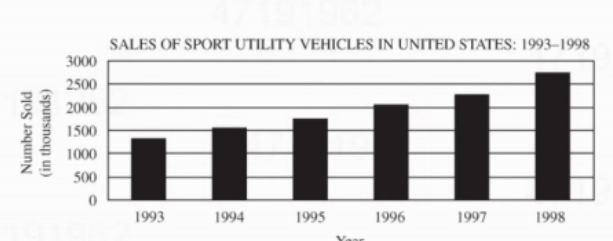
- A. 3 million
- B. 2.5 million
- C. 2 million
- D. 3 thousand
Correct Answer & Rationale
Correct Answer: A
To determine the approximate number of sport utility vehicles sold in 1999, analyzing the trend in the graph is essential. If the upward trend continued, sales would likely increase compared to previous years. Given the data, 3 million aligns with the projected growth rate, reflecting a significant rise consistent with market trends. Option B, 2.5 million, underestimates the growth, while C, 2 million, does not account for the upward trajectory. Option D, 3 thousand, is far too low and unrealistic, failing to represent the scale of SUV sales during that period. Thus, 3 million is the most reasonable estimate.
To determine the approximate number of sport utility vehicles sold in 1999, analyzing the trend in the graph is essential. If the upward trend continued, sales would likely increase compared to previous years. Given the data, 3 million aligns with the projected growth rate, reflecting a significant rise consistent with market trends. Option B, 2.5 million, underestimates the growth, while C, 2 million, does not account for the upward trajectory. Option D, 3 thousand, is far too low and unrealistic, failing to represent the scale of SUV sales during that period. Thus, 3 million is the most reasonable estimate.
(a ^ 9 * b ^ 12)/(a ^ 3 * b) =
- A. a ^ 3 * b ^ 11
- B. a ^ 6 * b ^ 12
- C. a ^ 3 * b ^ 12
- D. a ^ 6 * b ^ 11
Correct Answer & Rationale
Correct Answer: D
To simplify the expression \((a^9 * b^{12})/(a^3 * b)\), apply the laws of exponents. For the \(a\) terms, subtract the exponents: \(9 - 3 = 6\), giving \(a^6\). For the \(b\) terms, also subtract the exponents: \(12 - 1 = 11\), resulting in \(b^{11}\). Thus, the simplified expression is \(a^6 * b^{11}\). Option A is incorrect because it miscalculates the exponent of \(b\). Option B incorrectly maintains the exponent of \(b\) at 12. Option C fails to adjust the exponent of \(a\) correctly. Only option D accurately reflects the simplification.
To simplify the expression \((a^9 * b^{12})/(a^3 * b)\), apply the laws of exponents. For the \(a\) terms, subtract the exponents: \(9 - 3 = 6\), giving \(a^6\). For the \(b\) terms, also subtract the exponents: \(12 - 1 = 11\), resulting in \(b^{11}\). Thus, the simplified expression is \(a^6 * b^{11}\). Option A is incorrect because it miscalculates the exponent of \(b\). Option B incorrectly maintains the exponent of \(b\) at 12. Option C fails to adjust the exponent of \(a\) correctly. Only option D accurately reflects the simplification.
In the figure above, what is the average (arithmetic mean) of w, x, y, and z?
- A. 90
- B. 100
- C. 120
- D. It cannot be determined from the information given.
Correct Answer & Rationale
Correct Answer: D
To find the average of w, x, y, and z, all values must be known. Option D is valid since the problem does not provide specific values or relationships between these variables, making it impossible to calculate their average. Option A (90), Option B (100), and Option C (120) suggest definitive averages, but without concrete data on w, x, y, and z, these answers cannot be substantiated. Each of these options assumes values that may not exist or be accurate, highlighting the necessity of complete information for such calculations.
To find the average of w, x, y, and z, all values must be known. Option D is valid since the problem does not provide specific values or relationships between these variables, making it impossible to calculate their average. Option A (90), Option B (100), and Option C (120) suggest definitive averages, but without concrete data on w, x, y, and z, these answers cannot be substantiated. Each of these options assumes values that may not exist or be accurate, highlighting the necessity of complete information for such calculations.
Which equation is a correct way to calculate x?
- A. sin x=5,000 /7,000
- B. sin x= 7,000 /5,000
- C. tan x= 5,000/7,000
- D. tan x=7,000/5,000
Correct Answer & Rationale
Correct Answer: C
To solve for \( x \), the correct relationship involves the tangent function, as \( \tan \) is defined as the ratio of the opposite side to the adjacent side in a right triangle. Option C, \( \tan x = \frac{5,000}{7,000} \), accurately represents this ratio. Option A misapplies the sine function, which should represent the ratio of the opposite side to the hypotenuse, not the adjacent side. Similarly, option B incorrectly uses sine but with the sides reversed, leading to an inaccurate representation. Option D misuses tangent, suggesting the opposite and adjacent sides are swapped, which does not align with the definition of tangent. Thus, only option C correctly applies the tangent function to find \( x \).
To solve for \( x \), the correct relationship involves the tangent function, as \( \tan \) is defined as the ratio of the opposite side to the adjacent side in a right triangle. Option C, \( \tan x = \frac{5,000}{7,000} \), accurately represents this ratio. Option A misapplies the sine function, which should represent the ratio of the opposite side to the hypotenuse, not the adjacent side. Similarly, option B incorrectly uses sine but with the sides reversed, leading to an inaccurate representation. Option D misuses tangent, suggesting the opposite and adjacent sides are swapped, which does not align with the definition of tangent. Thus, only option C correctly applies the tangent function to find \( x \).