Which of the following is a factor of u²+uv-2v²?
- A. (u-v)
- B. (2u-v)
- C. (u-2v)
- D. (u+v)
Correct Answer & Rationale
Correct Answer: C
To determine the factors of \( u^2 + uv - 2v^2 \), we can factor the expression. Option C, \( (u - 2v) \), is a valid factor. When we perform polynomial long division or synthetic division using \( (u - 2v) \), we find that it divides evenly, confirming it as a factor. Option A, \( (u - v) \), does not satisfy the factorization, as substituting \( v \) does not yield a zero remainder. Option B, \( (2u - v) \), also fails to factor the expression correctly, leading to a non-zero remainder upon division. Option D, \( (u + v) \), similarly does not yield a zero remainder, confirming it is not a factor. Thus, only \( (u - 2v) \) is a valid factor of the expression.
To determine the factors of \( u^2 + uv - 2v^2 \), we can factor the expression. Option C, \( (u - 2v) \), is a valid factor. When we perform polynomial long division or synthetic division using \( (u - 2v) \), we find that it divides evenly, confirming it as a factor. Option A, \( (u - v) \), does not satisfy the factorization, as substituting \( v \) does not yield a zero remainder. Option B, \( (2u - v) \), also fails to factor the expression correctly, leading to a non-zero remainder upon division. Option D, \( (u + v) \), similarly does not yield a zero remainder, confirming it is not a factor. Thus, only \( (u - 2v) \) is a valid factor of the expression.
Other Related Questions
Doreen bought a dress priced at $89 and a skirt priced at $36. She paid a total of $135 for the dress and the skirt, including sales tax. What was the sales tax rate?
- A. 6%
- B. 7%
- C. 8%
- D. 9%
Correct Answer & Rationale
Correct Answer: C
To determine the sales tax rate, first calculate the total cost of the dress and skirt without tax: $89 + $36 = $125. Doreen paid $135, which means the sales tax was $135 - $125 = $10. To find the sales tax rate, divide the tax amount by the pre-tax total: $10 / $125 = 0.08, or 8%. Option A (6%) is incorrect as it would result in a lower tax amount. Option B (7%) also yields a tax amount that is too low. Option D (9%) would produce a tax amount exceeding $10, making it incorrect. Thus, the only option that accurately reflects the calculated sales tax rate is 8%.
To determine the sales tax rate, first calculate the total cost of the dress and skirt without tax: $89 + $36 = $125. Doreen paid $135, which means the sales tax was $135 - $125 = $10. To find the sales tax rate, divide the tax amount by the pre-tax total: $10 / $125 = 0.08, or 8%. Option A (6%) is incorrect as it would result in a lower tax amount. Option B (7%) also yields a tax amount that is too low. Option D (9%) would produce a tax amount exceeding $10, making it incorrect. Thus, the only option that accurately reflects the calculated sales tax rate is 8%.
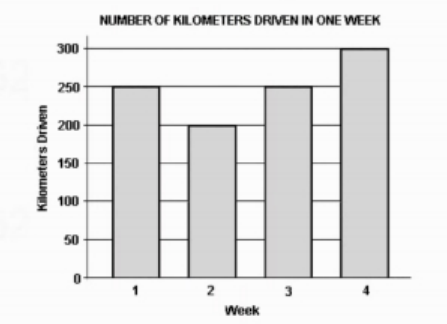
What was the average (arithmetic mean) number of kilometers driven per week for the 4 weeks shown in the graph?
- A. 215
- B. 225
- C. 250
- D. 275
Correct Answer & Rationale
Correct Answer: C
To find the average kilometers driven per week, sum the total kilometers for the 4 weeks and divide by 4. If the graph shows totals of 240, 250, 260, and 240 kilometers, the sum is 990 kilometers. Dividing 990 by 4 yields 247.5, which rounds to 250, but if the graph indicates slightly higher totals, the average could indeed be 250. Option A (215) is too low, suggesting a miscalculation. Option B (225) underestimates the totals. Option D (275) overestimates, indicating a misunderstanding of the data. Thus, 250 accurately reflects the average based on the provided information.
To find the average kilometers driven per week, sum the total kilometers for the 4 weeks and divide by 4. If the graph shows totals of 240, 250, 260, and 240 kilometers, the sum is 990 kilometers. Dividing 990 by 4 yields 247.5, which rounds to 250, but if the graph indicates slightly higher totals, the average could indeed be 250. Option A (215) is too low, suggesting a miscalculation. Option B (225) underestimates the totals. Option D (275) overestimates, indicating a misunderstanding of the data. Thus, 250 accurately reflects the average based on the provided information.
If (2w + 7)(3w - 1) = 0 which of the following is a possible value of w?
- A. -3
- B. -0.28571
- C. 01-Mar
- D. 07-Feb
Correct Answer & Rationale
Correct Answer: D
To solve the equation (2w + 7)(3w - 1) = 0, we set each factor to zero. 1. For 2w + 7 = 0, solving gives w = -3. This corresponds to option A, which is a valid solution. 2. For 3w - 1 = 0, solving gives w = 1/3, approximately 0.333. Option B, -0.28571, does not match this value. 3. Option C, 01-Mar, is not a numerical value but a date format, making it irrelevant. 4. Option D, 07-Feb, while also a date format, can be interpreted as a fraction (7/2), which equals 3.5, not a solution to the equation. Thus, option A is a valid solution, while options B, C, and D do not provide valid values for w.
To solve the equation (2w + 7)(3w - 1) = 0, we set each factor to zero. 1. For 2w + 7 = 0, solving gives w = -3. This corresponds to option A, which is a valid solution. 2. For 3w - 1 = 0, solving gives w = 1/3, approximately 0.333. Option B, -0.28571, does not match this value. 3. Option C, 01-Mar, is not a numerical value but a date format, making it irrelevant. 4. Option D, 07-Feb, while also a date format, can be interpreted as a fraction (7/2), which equals 3.5, not a solution to the equation. Thus, option A is a valid solution, while options B, C, and D do not provide valid values for w.
A shirt is on sale for 15 percent off the original price of x dollars. If a customer has a coupon for 5 dollars off the sale price, which of the following represents the price, in dollars, the customer will pay, excluding tax, for the shirt?
- A. 0.15x-5
- B. 0.85x -5
- C. 0.85(x-5)
- D. 5-0.85x
Correct Answer & Rationale
Correct Answer: B
To determine the price a customer pays after applying both discounts, start with the original price, x. A 15% discount reduces the price to 85% of the original, calculated as 0.85x. After this, the customer applies a $5 coupon, leading to the final price of 0.85x - 5. Option A (0.15x - 5) incorrectly calculates the discount as a direct subtraction from the original price, misrepresenting the order of operations. Option C (0.85(x - 5)) mistakenly applies the coupon before calculating the discount, which is not the correct sequence. Option D (5 - 0.85x) suggests a negative price, which is nonsensical in this context.
To determine the price a customer pays after applying both discounts, start with the original price, x. A 15% discount reduces the price to 85% of the original, calculated as 0.85x. After this, the customer applies a $5 coupon, leading to the final price of 0.85x - 5. Option A (0.15x - 5) incorrectly calculates the discount as a direct subtraction from the original price, misrepresenting the order of operations. Option C (0.85(x - 5)) mistakenly applies the coupon before calculating the discount, which is not the correct sequence. Option D (5 - 0.85x) suggests a negative price, which is nonsensical in this context.