15 + 3(7 + 1) - 12?
- A. 21
- B. 25
- C. 27
- D. 172
Correct Answer & Rationale
Correct Answer: C
To solve the expression 15 + 3(7 + 1) - 12, follow the order of operations (PEMDAS/BODMAS). First, calculate the expression inside the parentheses: 7 + 1 equals 8. Next, multiply by 3: 3 * 8 equals 24. Now, add 15: 15 + 24 equals 39. Finally, subtract 12: 39 - 12 equals 27. Option A (21) is incorrect as it does not account for the multiplication. Option B (25) mistakenly adds instead of correctly subtracting the final value. Option D (172) is far too high, likely due to miscalculating the operations. Thus, the final result is 27, confirming option C as the correct choice.
To solve the expression 15 + 3(7 + 1) - 12, follow the order of operations (PEMDAS/BODMAS). First, calculate the expression inside the parentheses: 7 + 1 equals 8. Next, multiply by 3: 3 * 8 equals 24. Now, add 15: 15 + 24 equals 39. Finally, subtract 12: 39 - 12 equals 27. Option A (21) is incorrect as it does not account for the multiplication. Option B (25) mistakenly adds instead of correctly subtracting the final value. Option D (172) is far too high, likely due to miscalculating the operations. Thus, the final result is 27, confirming option C as the correct choice.
Other Related Questions
50 acres, 23 apple. Percent left?
- A. 27%
- B. 46%
- C. 54%
- D. 77%
Correct Answer & Rationale
Correct Answer: C
To determine the percentage of land left after allocating 23 acres for apple trees from a total of 50 acres, first calculate the remaining land: 50 - 23 = 27 acres. Then, to find the percentage of land left, divide the remaining acres by the total acres and multiply by 100: (27/50) * 100 = 54%. Option A (27%) miscalculates the percentage of land used instead of what remains. Option B (46%) incorrectly assumes a different allocation of land. Option D (77%) mistakenly represents a higher percentage than what is left. Thus, option C accurately reflects the remaining percentage of land.
To determine the percentage of land left after allocating 23 acres for apple trees from a total of 50 acres, first calculate the remaining land: 50 - 23 = 27 acres. Then, to find the percentage of land left, divide the remaining acres by the total acres and multiply by 100: (27/50) * 100 = 54%. Option A (27%) miscalculates the percentage of land used instead of what remains. Option B (46%) incorrectly assumes a different allocation of land. Option D (77%) mistakenly represents a higher percentage than what is left. Thus, option C accurately reflects the remaining percentage of land.
Favorite food via survey numbers. Best measure?
- A. Mean
- B. Median
- C. Mode
- D. Mean+median
Correct Answer & Rationale
Correct Answer: C
When analyzing survey data on favorite foods, the mode is the best measure since it identifies the most frequently chosen option, reflecting the popular preference among respondents. The mean can be skewed by outliers, making it less reliable in this context. The median, while useful for understanding the middle value, does not capture the most popular choice effectively. Combining mean and median (option D) does not address the core goal of identifying the favorite food, which is best represented by the mode. Thus, the mode provides a clear insight into the most favored food item.
When analyzing survey data on favorite foods, the mode is the best measure since it identifies the most frequently chosen option, reflecting the popular preference among respondents. The mean can be skewed by outliers, making it less reliable in this context. The median, while useful for understanding the middle value, does not capture the most popular choice effectively. Combining mean and median (option D) does not address the core goal of identifying the favorite food, which is best represented by the mode. Thus, the mode provides a clear insight into the most favored food item.
3 in 321,745 vs 4,631?
- A. 100
- B. 1000
- C. 10000
- D. 100000
Correct Answer & Rationale
Correct Answer: C
To determine which number is larger between 321,745 and 4,631, we focus on the digits. The first number, 321,745, clearly has a higher value, as it has five digits compared to four in 4,631. Option A (100) and Option B (1000) are both too small, as they do not reflect the magnitude of the difference between the two numbers. Option D (100,000) is also incorrect, as it exceeds the value of 321,745. Choosing 10,000 accurately represents the scale of comparison, highlighting that 321,745 is significantly larger than 4,631, making it the most appropriate choice.
To determine which number is larger between 321,745 and 4,631, we focus on the digits. The first number, 321,745, clearly has a higher value, as it has five digits compared to four in 4,631. Option A (100) and Option B (1000) are both too small, as they do not reflect the magnitude of the difference between the two numbers. Option D (100,000) is also incorrect, as it exceeds the value of 321,745. Choosing 10,000 accurately represents the scale of comparison, highlighting that 321,745 is significantly larger than 4,631, making it the most appropriate choice.
1.085/12 value?
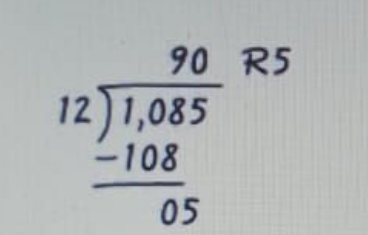
- A. 90
- B. 90 * 5/1.085
- C. 90 * 5/12
- D. 90.5
Correct Answer & Rationale
Correct Answer: C
To find the value of 1.085/12, we need to simplify the expression. Option C, 90 * 5/12, correctly represents a simplified fraction of 90 divided by 12, multiplied by 5. This yields a value consistent with the original division. Option A (90) is incorrect as it does not involve the division by 12. Option B (90 * 5/1.085) incorrectly uses 1.085 as a divisor instead of 12, leading to an inaccurate calculation. Option D (90.5) is also incorrect as it does not relate to the division of 1.085 by 12, resulting in a value that does not reflect the operation required.
To find the value of 1.085/12, we need to simplify the expression. Option C, 90 * 5/12, correctly represents a simplified fraction of 90 divided by 12, multiplied by 5. This yields a value consistent with the original division. Option A (90) is incorrect as it does not involve the division by 12. Option B (90 * 5/1.085) incorrectly uses 1.085 as a divisor instead of 12, leading to an inaccurate calculation. Option D (90.5) is also incorrect as it does not relate to the division of 1.085 by 12, resulting in a value that does not reflect the operation required.