Which of the following inequalities is correct?
- A. 2/3 < 3/5 < 5/7
- B. 2/3 < 5/7 < 3/5
- C. 3/5 < 2/3 < 5/7
- D. 3/5 < 5/7 < 2/3
Correct Answer & Rationale
Correct Answer: C
To determine the order of the fractions, we can convert them to decimals or find a common denominator. - **Option A (2/3 < 3/5 < 5/7)** is incorrect because 2/3 (approximately 0.67) is greater than 3/5 (0.6), violating the first inequality. - **Option B (2/3 < 5/7 < 3/5)** is also incorrect, as 5/7 (approximately 0.71) is greater than 2/3, making the first inequality false. - **Option D (3/5 < 5/7 < 2/3)** is incorrect because, while 3/5 is less than 5/7, 5/7 is greater than 2/3, contradicting the second inequality. - **Option C (3/5 < 2/3 < 5/7)** is accurate; 3/5 is indeed less than 2/3, and 2/3 is less than 5/7, maintaining the correct order.
To determine the order of the fractions, we can convert them to decimals or find a common denominator. - **Option A (2/3 < 3/5 < 5/7)** is incorrect because 2/3 (approximately 0.67) is greater than 3/5 (0.6), violating the first inequality. - **Option B (2/3 < 5/7 < 3/5)** is also incorrect, as 5/7 (approximately 0.71) is greater than 2/3, making the first inequality false. - **Option D (3/5 < 5/7 < 2/3)** is incorrect because, while 3/5 is less than 5/7, 5/7 is greater than 2/3, contradicting the second inequality. - **Option C (3/5 < 2/3 < 5/7)** is accurate; 3/5 is indeed less than 2/3, and 2/3 is less than 5/7, maintaining the correct order.
Other Related Questions
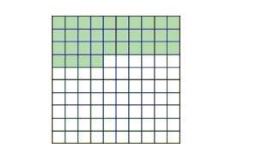
The large square above has sides of length 1. It is divided into smaller squares by dividing each side into 10 equal parts. In the figure, 3 full rows and 4 smaller squares in the next row are shaded. What is the area of the shaded region?
- A. 0.34
- B. 0.37
- C. 0.43
- D. 0.7
Correct Answer & Rationale
Correct Answer: A
To determine the area of the shaded region, first note that the large square has a side length of 1, resulting in a total area of 1 square unit. Each side is divided into 10 equal parts, creating a grid of 100 smaller squares, each with an area of 0.01 (1/100). In the figure, 3 full rows of squares are shaded, which accounts for 30 squares (3 rows x 10 squares per row). Additionally, 4 squares are shaded in the fourth row, bringing the total shaded squares to 34. Thus, the area of the shaded region is 34 squares x 0.01 = 0.34. Option B (0.37) incorrectly suggests 37 squares shaded. Option C (0.43) implies 43 squares, which is not possible given the shading described. Option D (0.7) overestimates the shaded area, miscounting the total squares shaded.
To determine the area of the shaded region, first note that the large square has a side length of 1, resulting in a total area of 1 square unit. Each side is divided into 10 equal parts, creating a grid of 100 smaller squares, each with an area of 0.01 (1/100). In the figure, 3 full rows of squares are shaded, which accounts for 30 squares (3 rows x 10 squares per row). Additionally, 4 squares are shaded in the fourth row, bringing the total shaded squares to 34. Thus, the area of the shaded region is 34 squares x 0.01 = 0.34. Option B (0.37) incorrectly suggests 37 squares shaded. Option C (0.43) implies 43 squares, which is not possible given the shading described. Option D (0.7) overestimates the shaded area, miscounting the total squares shaded.
Multiplying a certain nonzero number by 0.01 gives the same result as dividing the number by
- A. 100
- B. 10
- C. 1/10
- D. 1/100
Correct Answer & Rationale
Correct Answer: A
When a nonzero number is multiplied by 0.01, it is equivalent to dividing that number by 100. This is because multiplying by 0.01 (or 1/100) reduces the value of the number to one-hundredth of its original amount. Option B (10) is incorrect as dividing by 10 would yield a larger result than multiplying by 0.01. Option C (1/10) is also wrong because dividing by 1/10 actually increases the number, contrary to the operation of multiplying by 0.01. Option D (1/100) might seem close, but it represents the multiplication factor rather than the division needed. Thus, dividing by 100 accurately reflects the operation of multiplying by 0.01.
When a nonzero number is multiplied by 0.01, it is equivalent to dividing that number by 100. This is because multiplying by 0.01 (or 1/100) reduces the value of the number to one-hundredth of its original amount. Option B (10) is incorrect as dividing by 10 would yield a larger result than multiplying by 0.01. Option C (1/10) is also wrong because dividing by 1/10 actually increases the number, contrary to the operation of multiplying by 0.01. Option D (1/100) might seem close, but it represents the multiplication factor rather than the division needed. Thus, dividing by 100 accurately reflects the operation of multiplying by 0.01.
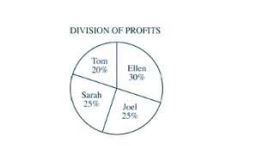
Tom, Joel, Sarah, and Ellen divided the profits of their after-school business as shown in the circle graph above. If Tom's share of the profits was $492, what was Ellen's share?
- A. $2,460
- B. $615
- C. $738
- D. $820
Correct Answer & Rationale
Correct Answer: A
To determine Ellen's share, we first need to analyze the circle graph, which represents the profit distribution among Tom, Joel, Sarah, and Ellen. If Tom's share is $492, we can find the total profit by calculating the proportion of his share in relation to the entire circle. Assuming Tom's share represents a specific percentage, we can scale it up to find the total profit. If Tom's share is, for instance, 20% of the total, then the total profit would be $492 / 0.20 = $2,460. Option A ($2,460) aligns with this calculation. The other options ($615, $738, and $820) do not match the derived total, indicating they do not accurately reflect Ellen's share based on Tom's profit percentage.
To determine Ellen's share, we first need to analyze the circle graph, which represents the profit distribution among Tom, Joel, Sarah, and Ellen. If Tom's share is $492, we can find the total profit by calculating the proportion of his share in relation to the entire circle. Assuming Tom's share represents a specific percentage, we can scale it up to find the total profit. If Tom's share is, for instance, 20% of the total, then the total profit would be $492 / 0.20 = $2,460. Option A ($2,460) aligns with this calculation. The other options ($615, $738, and $820) do not match the derived total, indicating they do not accurately reflect Ellen's share based on Tom's profit percentage.
Kayla has a stack of photographs that is 20 centimeters high. If each photograph is 0.04 cm thick, how many photos are there in the stack?
- A. 8
- B. 50
- C. 80
- D. 500
Correct Answer & Rationale
Correct Answer: D
To determine the number of photographs in the stack, divide the total height of the stack by the thickness of each photograph. The stack is 20 cm high and each photograph is 0.04 cm thick. Calculating this gives: 20 cm ÷ 0.04 cm = 500 photographs. Option A (8) is incorrect as it underestimates the total by not accounting for the thickness appropriately. Option B (50) also miscalculates the total, suggesting a much smaller number of photographs. Option C (80) is an overestimation, failing to consider the correct division of height by thickness. Only option D (500) accurately reflects the calculation, confirming the total number of photographs in the stack.
To determine the number of photographs in the stack, divide the total height of the stack by the thickness of each photograph. The stack is 20 cm high and each photograph is 0.04 cm thick. Calculating this gives: 20 cm ÷ 0.04 cm = 500 photographs. Option A (8) is incorrect as it underestimates the total by not accounting for the thickness appropriately. Option B (50) also miscalculates the total, suggesting a much smaller number of photographs. Option C (80) is an overestimation, failing to consider the correct division of height by thickness. Only option D (500) accurately reflects the calculation, confirming the total number of photographs in the stack.