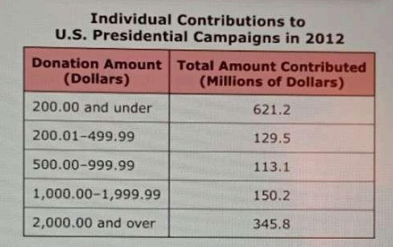
The table and the article are based on information from the U.S. Federal Election Commission.
U.S. presidential candidates receive financial contributions from many different sources. For the 2012 election cycle, political parties reported contributions of $34,750 to all candidates. Political action committees, groups that raise money to give to campaigns, reported contributions of $1.7 million to all candidates. Candidates personally contributed $5.8 million to their own campaigns. Additionally, the Presidential Election Campaign Fund, to which citizens may contribute by checking a box on their federal tax forms, gave $1.3 million to all candidates. The remainder came from individual contributions as shown in the table.
Which conclusion is best supported by information in the table and article?
- A. Individuals contributed a total amount of money equal to the total of all other sources of donations.
- B. Individuals contributing the smallest quantity of money insignificantly impact presidential campaigns.
- C. Individuals donated the greatest total amount although many contributions were relatively small.
- D. Individuals have more influence on the proposed policies of presidential candidates than groups do.
Correct Answer & Rationale
Correct Answer: C
Option C is supported by the data, indicating that while many individual contributions were small, they collectively formed the largest portion of total donations to presidential campaigns. This highlights the significant role individuals play despite the size of their contributions. Option A is incorrect as it suggests individuals’ contributions equaled all other sources, which is not supported by the data. Option B misrepresents the impact of smaller donations; even small contributions can collectively influence campaign funding significantly. Option D overstates individuals' influence on policy compared to groups, which often have more resources and organized lobbying power.
Option C is supported by the data, indicating that while many individual contributions were small, they collectively formed the largest portion of total donations to presidential campaigns. This highlights the significant role individuals play despite the size of their contributions. Option A is incorrect as it suggests individuals’ contributions equaled all other sources, which is not supported by the data. Option B misrepresents the impact of smaller donations; even small contributions can collectively influence campaign funding significantly. Option D overstates individuals' influence on policy compared to groups, which often have more resources and organized lobbying power.
Other Related Questions
Which statement is based on the text?
- A. Individuals spend their income in factor markets.
- B. Entrepreneurs profit from participation in product markets.
- C. Individuals sell their labor in factor markets.
- D. Resources are traded in product markets.
Correct Answer & Rationale
Correct Answer: C
Option C accurately reflects the concept that individuals offer their labor in factor markets, where resources like labor are exchanged for wages. This aligns with economic principles regarding labor supply. Option A is incorrect since individuals do not spend income in factor markets; rather, they purchase goods and services in product markets. Option B misrepresents the role of entrepreneurs, who primarily earn profits through innovation and sales in product markets, not simply from participation. Option D is also misleading, as resources are exchanged in factor markets, while product markets focus on the sale of finished goods and services.
Option C accurately reflects the concept that individuals offer their labor in factor markets, where resources like labor are exchanged for wages. This aligns with economic principles regarding labor supply. Option A is incorrect since individuals do not spend income in factor markets; rather, they purchase goods and services in product markets. Option B misrepresents the role of entrepreneurs, who primarily earn profits through innovation and sales in product markets, not simply from participation. Option D is also misleading, as resources are exchanged in factor markets, while product markets focus on the sale of finished goods and services.
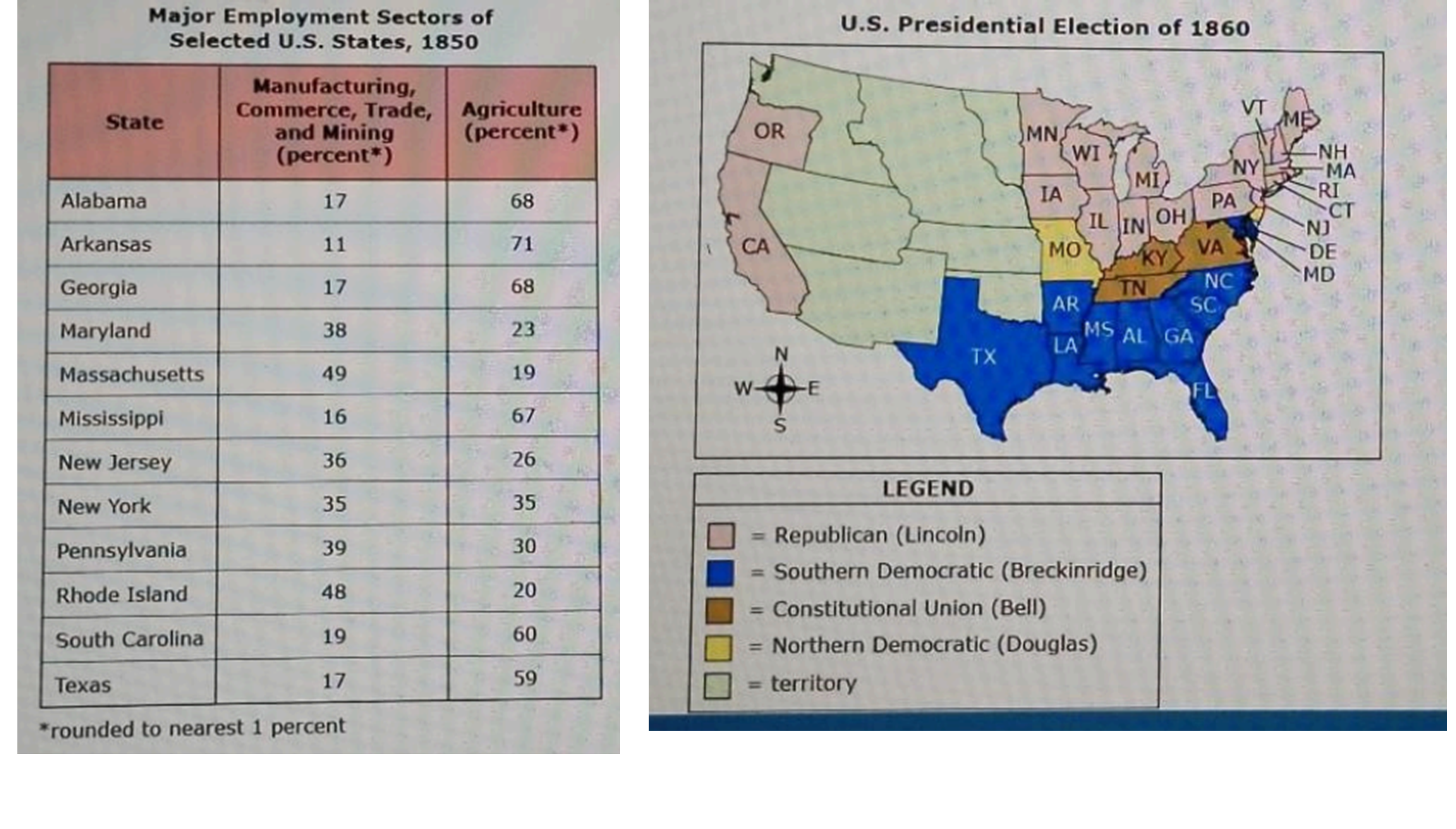
Which statement is supported by both the table and the map?
- A. Differences in the total populations of the states led to political differences between the North and the South.
- B. Differences among the economies of the states contributed to political differences between the North and the South.
- C. Political differences between the North and the South reflected differences in education among the states.
- D. Political differences between the North and the South reflected differences in the standards of living in the states.
Correct Answer & Rationale
Correct Answer: B
Option B is supported by both the table and the map, as they illustrate how varying economic structures—such as agriculture in the South versus industrialization in the North—contributed to distinct political ideologies and policies. Option A incorrectly attributes political differences solely to population size, overlooking the economic factors at play. Option C suggests education differences as the main cause, which is not evident in the provided data. Option D implies that living standards were the primary influence, but the economic context is more directly linked to the political divide. Thus, B effectively encapsulates the relationship between economy and political differences.
Option B is supported by both the table and the map, as they illustrate how varying economic structures—such as agriculture in the South versus industrialization in the North—contributed to distinct political ideologies and policies. Option A incorrectly attributes political differences solely to population size, overlooking the economic factors at play. Option C suggests education differences as the main cause, which is not evident in the provided data. Option D implies that living standards were the primary influence, but the economic context is more directly linked to the political divide. Thus, B effectively encapsulates the relationship between economy and political differences.
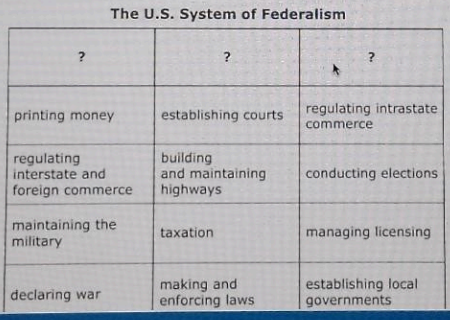
Complete the U.S. System of Federalism chart based on information from the passage. Click on the title below you want to select and drag it into the top of each column in the chart. - State Government Powers - National Government Powers - Shared Powers of National and State Governments -
Correct Answer & Rationale
Correct Answer:
In the U.S. system of federalism, powers are distributed among different levels of government. **State Government Powers** include authority over education, transportation, and local law enforcement, allowing states to address local needs effectively. **National Government Powers** encompass defense, foreign affairs, and immigration, ensuring a unified national policy in these critical areas. **Shared Powers** involve taxation, infrastructure, and law enforcement, illustrating collaboration between state and national governments to maintain order and promote welfare. Other options may misplace powers or overlook the collaborative nature of federalism, leading to misunderstandings about government functions.
In the U.S. system of federalism, powers are distributed among different levels of government. **State Government Powers** include authority over education, transportation, and local law enforcement, allowing states to address local needs effectively. **National Government Powers** encompass defense, foreign affairs, and immigration, ensuring a unified national policy in these critical areas. **Shared Powers** involve taxation, infrastructure, and law enforcement, illustrating collaboration between state and national governments to maintain order and promote welfare. Other options may misplace powers or overlook the collaborative nature of federalism, leading to misunderstandings about government functions.
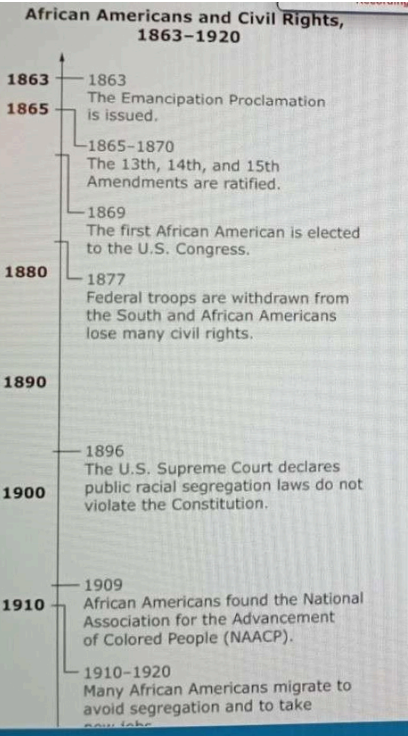
The newspaper writer's opinion that
- A. slavery should have been preserved
- B. Jim Crow laws should have been stopped
- C. Jim Crow laws benefited the south
- D. Jim Crow laws had benefited the South constitutional changes were successful
Correct Answer & Rationale
Correct Answer: C
The opinion that Jim Crow laws benefited the South reflects a perspective that views these discriminatory laws as advantageous for maintaining social order and economic benefits for white populations, despite their oppressive nature. Option A suggests a support for slavery, which is widely condemned and not a mainstream opinion. Option B advocates for the cessation of Jim Crow laws, opposing the notion that they were beneficial. Option D incorrectly implies that constitutional changes related to Jim Crow were successful, overlooking the ongoing struggles for civil rights and equality. Thus, option C captures a historically inaccurate yet prevalent viewpoint of the time.
The opinion that Jim Crow laws benefited the South reflects a perspective that views these discriminatory laws as advantageous for maintaining social order and economic benefits for white populations, despite their oppressive nature. Option A suggests a support for slavery, which is widely condemned and not a mainstream opinion. Option B advocates for the cessation of Jim Crow laws, opposing the notion that they were beneficial. Option D incorrectly implies that constitutional changes related to Jim Crow were successful, overlooking the ongoing struggles for civil rights and equality. Thus, option C captures a historically inaccurate yet prevalent viewpoint of the time.