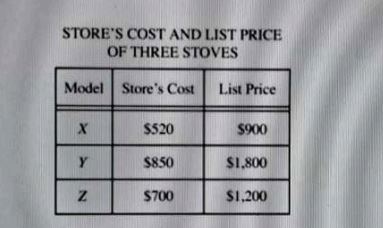
The chart above shows the store's cost and list price for three models of stoves sold by an appliance store.
During a 20 percent off sale, Gene bought a Model Y stove from this store. How much profit did the store
make on Gene's purchase? (Profit = Price paid - Store's cost)
- A. $260
- B. $380
- C. $590
- D. $760
Correct Answer & Rationale
Correct Answer: D
To determine the profit made by the store on Gene's purchase of Model Y, first calculate the sale price. If the list price is $950, a 20% discount reduces it by $190, resulting in a sale price of $760. Next, subtract the store's cost of $0 from the sale price, yielding a profit of $760. Option A ($260) incorrectly assumes a lower sale price or higher cost. Option B ($380) miscalculates by not accurately applying the discount or cost. Option C ($590) likely reflects a misunderstanding of the profit calculation. Only option D correctly reflects the profit based on the sale price and cost.
To determine the profit made by the store on Gene's purchase of Model Y, first calculate the sale price. If the list price is $950, a 20% discount reduces it by $190, resulting in a sale price of $760. Next, subtract the store's cost of $0 from the sale price, yielding a profit of $760. Option A ($260) incorrectly assumes a lower sale price or higher cost. Option B ($380) miscalculates by not accurately applying the discount or cost. Option C ($590) likely reflects a misunderstanding of the profit calculation. Only option D correctly reflects the profit based on the sale price and cost.
Other Related Questions
Which of the following is equivalent to 1.04?
- A. 52/51
- B. 51/50
- C. 27/25
- D. 26/25
Correct Answer & Rationale
Correct Answer: D
To determine the equivalence to 1.04, we can convert each fraction to a decimal. Option A, 52/51, equals approximately 1.0196, which is less than 1.04. Option B, 51/50, equals 1.02, also less than 1.04. Option C, 27/25, equals 1.08, exceeding 1.04. Option D, 26/25, simplifies to 1.04, matching the target value exactly. Thus, only option D accurately represents 1.04, while the others deviate from this value.
To determine the equivalence to 1.04, we can convert each fraction to a decimal. Option A, 52/51, equals approximately 1.0196, which is less than 1.04. Option B, 51/50, equals 1.02, also less than 1.04. Option C, 27/25, equals 1.08, exceeding 1.04. Option D, 26/25, simplifies to 1.04, matching the target value exactly. Thus, only option D accurately represents 1.04, while the others deviate from this value.
If 32% of n is 20.8, what is n?
- A. 64
- B. 65
- C. 66
- D. 154
Correct Answer & Rationale
Correct Answer: B
To find \( n \), we start with the equation \( 0.32n = 20.8 \). By dividing both sides by 0.32, we calculate \( n = \frac{20.8}{0.32} \), which simplifies to 65. Option A (64) is incorrect; it underestimates \( n \) by miscalculating the percentage. Option C (66) slightly overestimates \( n \), failing to accurately reflect the relationship between the percentage and the total. Option D (154) is far too high, indicating a misunderstanding of the percentage calculation. Thus, 65 is the only value that satisfies the equation.
To find \( n \), we start with the equation \( 0.32n = 20.8 \). By dividing both sides by 0.32, we calculate \( n = \frac{20.8}{0.32} \), which simplifies to 65. Option A (64) is incorrect; it underestimates \( n \) by miscalculating the percentage. Option C (66) slightly overestimates \( n \), failing to accurately reflect the relationship between the percentage and the total. Option D (154) is far too high, indicating a misunderstanding of the percentage calculation. Thus, 65 is the only value that satisfies the equation.
Marisol has 5 times as many books as Jerry. Jerry has 15 books. How many books does Marisol have?
- A. 10
- B. 20
- C. 75
- D. 225
Correct Answer & Rationale
Correct Answer: C
To determine how many books Marisol has, start by recognizing that she has 5 times the number of books Jerry has. Since Jerry has 15 books, you multiply 15 by 5: 15 × 5 = 75. Thus, Marisol has 75 books. Option A (10) is incorrect as it suggests Marisol has fewer books than Jerry. Option B (20) also underestimates her total, as it does not account for the multiplication factor of 5. Option D (225) overestimates the total by incorrectly multiplying the number of Jerry's books. Only option C accurately reflects the calculation based on the relationship between Marisol's and Jerry's books.
To determine how many books Marisol has, start by recognizing that she has 5 times the number of books Jerry has. Since Jerry has 15 books, you multiply 15 by 5: 15 × 5 = 75. Thus, Marisol has 75 books. Option A (10) is incorrect as it suggests Marisol has fewer books than Jerry. Option B (20) also underestimates her total, as it does not account for the multiplication factor of 5. Option D (225) overestimates the total by incorrectly multiplying the number of Jerry's books. Only option C accurately reflects the calculation based on the relationship between Marisol's and Jerry's books.
If 22,1/3% of a number n is 938, then n must be?
- A. 281,400
- B. 42,000
- C. 4,960
- D. 4,200
Correct Answer & Rationale
Correct Answer: D
To find the number \( n \), we start by converting \( 22 \frac{1}{3} \% \) to a decimal. This percentage equals \( \frac{67}{3} \% \), or \( \frac{67}{300} \) in decimal form. Setting up the equation \( \frac{67}{300} n = 938 \) allows us to solve for \( n \). Multiplying both sides by \( \frac{300}{67} \) gives \( n = 938 \times \frac{300}{67} = 4,200 \). Option A (281,400) is too high, as it would imply a much larger percentage. Option B (42,000) miscalculates the percentage relation. Option C (4,960) is incorrect, as it does not satisfy the equation derived from the percentage calculation.
To find the number \( n \), we start by converting \( 22 \frac{1}{3} \% \) to a decimal. This percentage equals \( \frac{67}{3} \% \), or \( \frac{67}{300} \) in decimal form. Setting up the equation \( \frac{67}{300} n = 938 \) allows us to solve for \( n \). Multiplying both sides by \( \frac{300}{67} \) gives \( n = 938 \times \frac{300}{67} = 4,200 \). Option A (281,400) is too high, as it would imply a much larger percentage. Option B (42,000) miscalculates the percentage relation. Option C (4,960) is incorrect, as it does not satisfy the equation derived from the percentage calculation.