At the Crest Coffee Shop, the cost of a plain bagel was $0.75 last year. This year the cost of a plain bagel is $0.90. By what percent did the cost of a plain bagel increase from last year to this year?
- A. 10%
- B. 15%
- C. 17%
- D. 20%
Correct Answer & Rationale
Correct Answer: D
To determine the percent increase in the cost of a plain bagel, the formula used is: \[ \text{Percent Increase} = \left( \frac{\text{New Price} - \text{Old Price}}{\text{Old Price}} \right) \times 100 \] Substituting the given values: \[ \text{Percent Increase} = \left( \frac{0.90 - 0.75}{0.75} \right) \times 100 = \left( \frac{0.15}{0.75} \right) \times 100 = 20\% \] Option A (10%) underestimates the increase, while B (15%) and C (17%) also fail to reflect the correct calculation. Therefore, the accurate calculation confirms a 20% increase in cost.
To determine the percent increase in the cost of a plain bagel, the formula used is: \[ \text{Percent Increase} = \left( \frac{\text{New Price} - \text{Old Price}}{\text{Old Price}} \right) \times 100 \] Substituting the given values: \[ \text{Percent Increase} = \left( \frac{0.90 - 0.75}{0.75} \right) \times 100 = \left( \frac{0.15}{0.75} \right) \times 100 = 20\% \] Option A (10%) underestimates the increase, while B (15%) and C (17%) also fail to reflect the correct calculation. Therefore, the accurate calculation confirms a 20% increase in cost.
Other Related Questions
Which of the four labeled points on the number line above has coordinate-?

- A. A
- B. B
- C. C
- D. D
Correct Answer & Rationale
Correct Answer: B
Point B is positioned at the coordinate -2 on the number line, making it the accurate choice. Point A is located at -1, which is not the specified coordinate. Point C is at 0, representing the origin, and thus does not match the target coordinate. Point D is found at 1, clearly outside the negative range required. Each of these points is distinctly marked, confirming that only Point B aligns with the coordinate of -2. This clarity in placement reinforces the understanding of negative values on a number line.
Point B is positioned at the coordinate -2 on the number line, making it the accurate choice. Point A is located at -1, which is not the specified coordinate. Point C is at 0, representing the origin, and thus does not match the target coordinate. Point D is found at 1, clearly outside the negative range required. Each of these points is distinctly marked, confirming that only Point B aligns with the coordinate of -2. This clarity in placement reinforces the understanding of negative values on a number line.
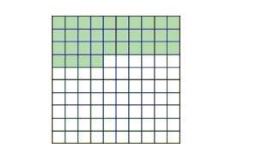
The large square above has sides of length 1. It is divided into smaller squares by dividing each side into 10 equal parts. In the figure, 3 full rows and 4 smaller squares in the next row are shaded. What is the area of the shaded region?
- A. 0.34
- B. 0.37
- C. 0.43
- D. 0.7
Correct Answer & Rationale
Correct Answer: A
To determine the area of the shaded region, first note that the large square has a side length of 1, resulting in a total area of 1 square unit. Each side is divided into 10 equal parts, creating a grid of 100 smaller squares, each with an area of 0.01 (1/100). In the figure, 3 full rows of squares are shaded, which accounts for 30 squares (3 rows x 10 squares per row). Additionally, 4 squares are shaded in the fourth row, bringing the total shaded squares to 34. Thus, the area of the shaded region is 34 squares x 0.01 = 0.34. Option B (0.37) incorrectly suggests 37 squares shaded. Option C (0.43) implies 43 squares, which is not possible given the shading described. Option D (0.7) overestimates the shaded area, miscounting the total squares shaded.
To determine the area of the shaded region, first note that the large square has a side length of 1, resulting in a total area of 1 square unit. Each side is divided into 10 equal parts, creating a grid of 100 smaller squares, each with an area of 0.01 (1/100). In the figure, 3 full rows of squares are shaded, which accounts for 30 squares (3 rows x 10 squares per row). Additionally, 4 squares are shaded in the fourth row, bringing the total shaded squares to 34. Thus, the area of the shaded region is 34 squares x 0.01 = 0.34. Option B (0.37) incorrectly suggests 37 squares shaded. Option C (0.43) implies 43 squares, which is not possible given the shading described. Option D (0.7) overestimates the shaded area, miscounting the total squares shaded.
½% of 20 is?
- A. 1/10
- B. 1/4
- C. 5
- D. 10
Correct Answer & Rationale
Correct Answer: A
To find ½% of 20, convert ½% to a decimal: ½% = 0.005. Then, multiply 0.005 by 20, resulting in 0.1. This value can be expressed as a fraction: 0.1 = 1/10, which corresponds to option A. Option B (1/4) equals 0.25, which is larger than ½% of 20. Option C (5) and option D (10) are significantly higher than 0.1. Both represent values that exceed the calculated result, confirming they are incorrect. Thus, option A is the only choice that accurately reflects ½% of 20.
To find ½% of 20, convert ½% to a decimal: ½% = 0.005. Then, multiply 0.005 by 20, resulting in 0.1. This value can be expressed as a fraction: 0.1 = 1/10, which corresponds to option A. Option B (1/4) equals 0.25, which is larger than ½% of 20. Option C (5) and option D (10) are significantly higher than 0.1. Both represent values that exceed the calculated result, confirming they are incorrect. Thus, option A is the only choice that accurately reflects ½% of 20.
Harriet took 48 minutes to ride her bike the distance from her house to the town library. If she rode at a constant rate, what fraction of the total distance did she ride in the first 12 minutes?
- A. 1/4
- B. 1/3
- C. 1/2
- D. 3/4
Correct Answer & Rationale
Correct Answer: A
To determine the fraction of the total distance Harriet rode in the first 12 minutes, we start by recognizing that she took 48 minutes for the entire trip. Riding at a constant rate means that her distance covered is proportional to the time spent riding. In 12 minutes, which is one-fourth of the total 48 minutes, she would have covered one-fourth of the total distance. Thus, the fraction of the total distance she rode in the first 12 minutes is 1/4. Options B (1/3), C (1/2), and D (3/4) misrepresent the proportion of time to total time. Each suggests a greater fraction than what corresponds to 12 minutes relative to 48 minutes, leading to incorrect conclusions about the distance covered.
To determine the fraction of the total distance Harriet rode in the first 12 minutes, we start by recognizing that she took 48 minutes for the entire trip. Riding at a constant rate means that her distance covered is proportional to the time spent riding. In 12 minutes, which is one-fourth of the total 48 minutes, she would have covered one-fourth of the total distance. Thus, the fraction of the total distance she rode in the first 12 minutes is 1/4. Options B (1/3), C (1/2), and D (3/4) misrepresent the proportion of time to total time. Each suggests a greater fraction than what corresponds to 12 minutes relative to 48 minutes, leading to incorrect conclusions about the distance covered.