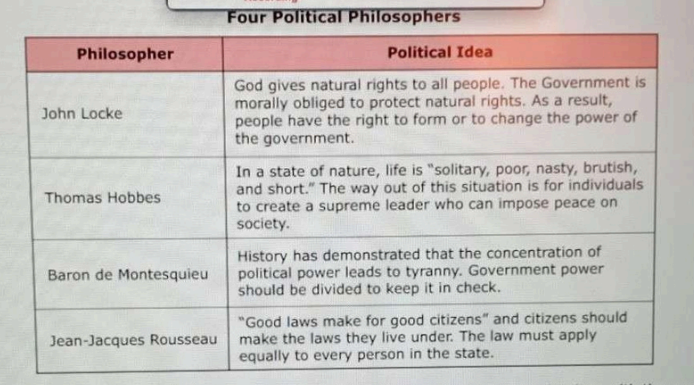
According to this information, which philosopher would most likely support the presidential power to appoint federal judges with the consent of the U.S. Senate?
- A. Thomas Hobbes
- B. Baron de Montesquieu
- C. Jean-Jacques Rousseau
- D. John Locke
Correct Answer & Rationale
Correct Answer: B
Baron de Montesquieu advocated for the separation of powers within government, emphasizing the need for checks and balances to prevent tyranny. His support for a collaborative process in appointing judges aligns with the presidential power requiring Senate consent, ensuring that no single branch holds excessive authority. Thomas Hobbes, on the other hand, favored a strong central authority and would likely support concentrated power without the need for Senate approval. Jean-Jacques Rousseau emphasized the general will and popular sovereignty, which does not directly address the judicial appointment process. John Locke valued consent and governance but did not specifically advocate for the Senate's role in judicial appointments.
Baron de Montesquieu advocated for the separation of powers within government, emphasizing the need for checks and balances to prevent tyranny. His support for a collaborative process in appointing judges aligns with the presidential power requiring Senate consent, ensuring that no single branch holds excessive authority. Thomas Hobbes, on the other hand, favored a strong central authority and would likely support concentrated power without the need for Senate approval. Jean-Jacques Rousseau emphasized the general will and popular sovereignty, which does not directly address the judicial appointment process. John Locke valued consent and governance but did not specifically advocate for the Senate's role in judicial appointments.
Other Related Questions
Which statement about the ratification of the 19th Amendment is based on the passage?
- A. Ratification was the result of the Seneca Falls Convention.
- B. Ratification occurred in return for the military service of women during World War I.
- C. Ratification occurred prior to the granting of voting rights to freed slaves.
- D. Ratification was the result of the accumulated efforts of women for decades.
Correct Answer & Rationale
Correct Answer: D
The ratification of the 19th Amendment was the culmination of decades of advocacy and activism by women who fought tirelessly for their voting rights, making option D the most accurate statement. Option A incorrectly attributes the ratification solely to the Seneca Falls Convention, which was just one of many events in the long struggle for women's suffrage. Option B suggests a direct exchange of military service for voting rights, which oversimplifies the complex social and political factors involved. Option C misrepresents the timeline, as the 19th Amendment was ratified after the Civil War, but the fight for voting rights for freed slaves and women evolved concurrently, not sequentially.
The ratification of the 19th Amendment was the culmination of decades of advocacy and activism by women who fought tirelessly for their voting rights, making option D the most accurate statement. Option A incorrectly attributes the ratification solely to the Seneca Falls Convention, which was just one of many events in the long struggle for women's suffrage. Option B suggests a direct exchange of military service for voting rights, which oversimplifies the complex social and political factors involved. Option C misrepresents the timeline, as the 19th Amendment was ratified after the Civil War, but the fight for voting rights for freed slaves and women evolved concurrently, not sequentially.
How did the position expressed by President Johnson differ from the position expressed by Senator Russell?
- A. Only Senator Russell said that state governments were sufficiently protecting the rights of citizens.
- B. Only Senator Russell supported the federal government's intervention.
- C. Only President Johnson supported the state governments' rights to manage their own affairs.
- D. Only President Johnson believed that the federal government was authorized to intervene.
Correct Answer & Rationale
Correct Answer: A
President Johnson emphasized the need for federal intervention to protect citizens' rights, believing that state governments were often inadequate. In contrast, Senator Russell argued that state governments were effectively safeguarding those rights, reflecting a stance of local governance. Option B is incorrect because Senator Russell did not support federal intervention. Option C misrepresents Johnson’s position; he favored federal oversight rather than state autonomy. Option D inaccurately attributes the belief in federal authority solely to Johnson, as Russell did not share this view. Thus, the distinction lies in Russell's confidence in state governments versus Johnson's call for federal action.
President Johnson emphasized the need for federal intervention to protect citizens' rights, believing that state governments were often inadequate. In contrast, Senator Russell argued that state governments were effectively safeguarding those rights, reflecting a stance of local governance. Option B is incorrect because Senator Russell did not support federal intervention. Option C misrepresents Johnson’s position; he favored federal oversight rather than state autonomy. Option D inaccurately attributes the belief in federal authority solely to Johnson, as Russell did not share this view. Thus, the distinction lies in Russell's confidence in state governments versus Johnson's call for federal action.
Based on the information in this passage, which feature of ancient Roman government most influenced the Founders in framing the U.S. Constitution?
- A. A popularly elected representative vetoed legislation.
- B. Magistrates proposed laws.
- C. A system of checks and balances limited power.
- D. Senators elected the consuls.
Correct Answer & Rationale
Correct Answer: C
The feature that most influenced the Founders in framing the U.S. Constitution is the system of checks and balances, which limited the power of government branches to prevent tyranny. This principle is evident in the U.S. system, where each branch can check the others, ensuring a balance of power. Option A is incorrect because while representatives play a role in legislation, the emphasis on a veto by a popularly elected official is not a defining characteristic of Roman governance. Option B, proposing laws by magistrates, describes a function of government but does not reflect the broader concept of power limitation. Option D incorrectly focuses on the election of consuls, which is less relevant to the Founders' emphasis on checks and balances.
The feature that most influenced the Founders in framing the U.S. Constitution is the system of checks and balances, which limited the power of government branches to prevent tyranny. This principle is evident in the U.S. system, where each branch can check the others, ensuring a balance of power. Option A is incorrect because while representatives play a role in legislation, the emphasis on a veto by a popularly elected official is not a defining characteristic of Roman governance. Option B, proposing laws by magistrates, describes a function of government but does not reflect the broader concept of power limitation. Option D incorrectly focuses on the election of consuls, which is less relevant to the Founders' emphasis on checks and balances.
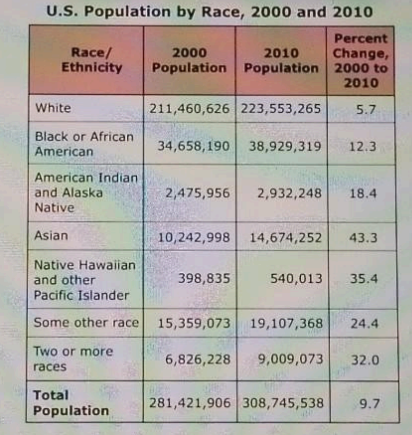
Which statement is correct about the change in racial and ethnic populations between 2000 and 2010?
- A. The Black or African American population had the greatest percentage of growth.
- B. The Native Hawaiian and other Pacific Islander population grew by a greater proportion than the Asian population.
- C. The White population experienced the slowest growth of all groups.
- D. The American Indian and Alaska Native population experienced almost no change.
Correct Answer & Rationale
Correct Answer: B
Option B accurately reflects demographic trends, as the Native Hawaiian and other Pacific Islander population indeed saw a higher percentage increase compared to the Asian population during this period. Option A is incorrect; while the Black or African American population grew, it was not the greatest percentage increase among all racial groups. Option C misrepresents the data; although the White population's growth was slower compared to previous decades, it was not the slowest overall. Option D is misleading as well; the American Indian and Alaska Native population did experience some growth, albeit modest, rather than remaining unchanged.
Option B accurately reflects demographic trends, as the Native Hawaiian and other Pacific Islander population indeed saw a higher percentage increase compared to the Asian population during this period. Option A is incorrect; while the Black or African American population grew, it was not the greatest percentage increase among all racial groups. Option C misrepresents the data; although the White population's growth was slower compared to previous decades, it was not the slowest overall. Option D is misleading as well; the American Indian and Alaska Native population did experience some growth, albeit modest, rather than remaining unchanged.