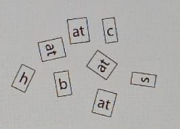
A teacher is working with a group of students at a literacy station. The students are expected to use the cards shown to form as many words as possible.
Which of the following concepts is best illustrated by the activity?
- A. Mastering sight words
- B. Working with syllabication
- C. Creating word families-
- D. Identifying prefixes and suffixes
Correct Answer & Rationale
Correct Answer: C
Creating word families demonstrates how words share a common base or root, allowing students to see relationships between words and enhance their vocabulary. This activity encourages learners to group words with similar structures, fostering an understanding of language patterns. Mastering sight words focuses on recognizing high-frequency words, which does not directly illustrate the concept of word families. Working with syllabication emphasizes breaking words into syllables rather than exploring their relationships. Identifying prefixes and suffixes involves understanding word parts but does not encompass the broader connections found in word families.
Creating word families demonstrates how words share a common base or root, allowing students to see relationships between words and enhance their vocabulary. This activity encourages learners to group words with similar structures, fostering an understanding of language patterns. Mastering sight words focuses on recognizing high-frequency words, which does not directly illustrate the concept of word families. Working with syllabication emphasizes breaking words into syllables rather than exploring their relationships. Identifying prefixes and suffixes involves understanding word parts but does not encompass the broader connections found in word families.
Other Related Questions
Active listening skills are best demonstrated by
- A. offering thoughtful feedback on someone's idea
- B. maintaining a neutral facial expression
- C. adding to a point by eagerly interjecting
- D. thinking of what to say next while in a discussion
Correct Answer & Rationale
Correct Answer: A
Active listening skills involve fully engaging with the speaker and demonstrating understanding. Offering thoughtful feedback on someone’s idea shows that you are processing their message and valuing their perspective, which is essential in active listening. Maintaining a neutral facial expression (B) may indicate a lack of engagement or emotion, which can hinder effective communication. Eagerly interjecting to add to a point (C) disrupts the flow of conversation and suggests that you are more focused on your own input than on listening. Lastly, thinking of what to say next while someone is speaking (D) detracts from truly understanding their message, as it diverts attention away from the speaker.
Active listening skills involve fully engaging with the speaker and demonstrating understanding. Offering thoughtful feedback on someone’s idea shows that you are processing their message and valuing their perspective, which is essential in active listening. Maintaining a neutral facial expression (B) may indicate a lack of engagement or emotion, which can hinder effective communication. Eagerly interjecting to add to a point (C) disrupts the flow of conversation and suggests that you are more focused on your own input than on listening. Lastly, thinking of what to say next while someone is speaking (D) detracts from truly understanding their message, as it diverts attention away from the speaker.
Which of the following words is best classified as domain-specific?
- A. Orange
- B. Masterpiece
- C. Friendship
- D. Precipitation
Correct Answer & Rationale
Correct Answer: D
Domain-specific vocabulary refers to terms that are specialized and relevant to a particular field or subject area. **D: Precipitation** is a scientific term used in meteorology to describe any form of water, liquid or solid, that falls from the atmosphere. It is specific to the study of weather and environmental science. **A: Orange** is a common noun referring to a fruit, lacking specialized context. **B: Masterpiece** denotes an exceptional work of art or craft but is not tied to a specific academic discipline. **C: Friendship** describes a social relationship and is a general term used across various contexts, not limited to a specific field.
Domain-specific vocabulary refers to terms that are specialized and relevant to a particular field or subject area. **D: Precipitation** is a scientific term used in meteorology to describe any form of water, liquid or solid, that falls from the atmosphere. It is specific to the study of weather and environmental science. **A: Orange** is a common noun referring to a fruit, lacking specialized context. **B: Masterpiece** denotes an exceptional work of art or craft but is not tied to a specific academic discipline. **C: Friendship** describes a social relationship and is a general term used across various contexts, not limited to a specific field.
During an oral presentation, which of the following strategies will best help a speaker facilitate audience comprehension of the material presented?
- A. Varying vocal volume
- B. Articulating words clearly
- C. Wearing proper attire
- D. Using hand gestures
Correct Answer & Rationale
Correct Answer: B
Articulating words clearly enhances audience comprehension by ensuring that every word is understood, which is essential for effective communication. This clarity allows listeners to grasp the content without confusion. Varying vocal volume (A) can enhance engagement but may not directly aid comprehension if clarity is sacrificed. Wearing proper attire (C) is important for professionalism but does not influence understanding of the material. Using hand gestures (D) can support the message but may distract if not used appropriately. Thus, clear articulation is the most effective strategy for facilitating comprehension.
Articulating words clearly enhances audience comprehension by ensuring that every word is understood, which is essential for effective communication. This clarity allows listeners to grasp the content without confusion. Varying vocal volume (A) can enhance engagement but may not directly aid comprehension if clarity is sacrificed. Wearing proper attire (C) is important for professionalism but does not influence understanding of the material. Using hand gestures (D) can support the message but may distract if not used appropriately. Thus, clear articulation is the most effective strategy for facilitating comprehension.
Which of the following is a compound-complex sentence?
- A. I want to go on vacation with Sally to Mexico, Costa Rica, and Florida.
- B. Even though the sun was shining, my mother told me I could not go to the pool.
- C. Holly needs to go to the grocery store, but she does not have enough time to go there today.
- D. Since we like to go on roller coasters, we go all the time, but we have not been on that coaster yet.
Correct Answer & Rationale
Correct Answer: D
A compound-complex sentence contains at least two independent clauses and one or more dependent clauses. Option D meets this criterion with "Since we like to go on roller coasters" (dependent clause) and "we go all the time, but we have not been on that coaster yet" (two independent clauses). Option A is a simple sentence with a list and lacks any dependent clauses. Option B contains one independent clause and one dependent clause, making it a complex sentence, not compound-complex. Option C is a compound sentence with two independent clauses but lacks a dependent clause. Thus, only option D fulfills the requirements for a compound-complex sentence.
A compound-complex sentence contains at least two independent clauses and one or more dependent clauses. Option D meets this criterion with "Since we like to go on roller coasters" (dependent clause) and "we go all the time, but we have not been on that coaster yet" (two independent clauses). Option A is a simple sentence with a list and lacks any dependent clauses. Option B contains one independent clause and one dependent clause, making it a complex sentence, not compound-complex. Option C is a compound sentence with two independent clauses but lacks a dependent clause. Thus, only option D fulfills the requirements for a compound-complex sentence.